
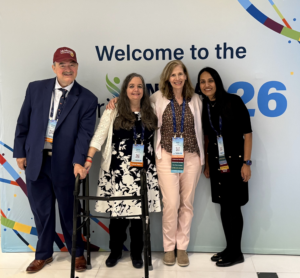
Members of CNTR’s Injury Research Engagement Panel (IREP) met up at the PCORI annual meeting: Jeff Wells, Debbie Marvel, Kelly Lang and Juanita Gonzalez.
The importance of engaging patients and caregivers as meaningful partners throughout the research process was a central theme of the 2026 Patient-Centered Outcomes Research Institute (PCORI) Annual Meeting, held October 19–20 in Washington, D.C. The two-day gathering brought together researchers, clinicians, patients, caregivers and advocates to share strategies for making healthcare research more relevant, inclusive and impactful.
Representing CNTR at the meeting was Director of Clinical Research Serina Zorrilla, joined by four members of CNTR’s Injury Research Engagement Panel (IREP): Kelly Lang, Debbie Marvel, Jeffrey Wells and Juanita Gonzalez.
For Serina, the meeting reinforced a fundamental principle of patient-centered research: patients and caregivers should have a meaningful voice in shaping research, rather than simply participating in in it.“Patients should be partners throughout the entire research enterprise, not simply participants in clinical studies,” she said.
Their lived experiences provide invaluable perspectives that can help identify meaningful research questions, prioritize outcomes that matter most to patients and families, inform study design and implementation, and ensure research findings are communicated in ways that are understandable and useful. “Patient engagement is equally important when translating research findings into clinical practices that improve care,” Serina added.
This emphasis on meaningful engagement was reflected throughout the conference, with discussions focused on building trust between researchers and patient partners, measuring the effectiveness of engagement efforts, and accelerating the adoption of evidence-based practices in healthcare settings. Sessions also explored emerging digital health technologies, including artificial intelligence, and the importance of ensuring that innovations address patients’ real-world needs.
One message particularly resonated with Serina: authentic engagement requires more than inviting patients to participate; it means genuinely listening to and incorporating their perspectives throughout the research process.
“One comment that has really stayed with me is the importance of not just engaging patients, but engaging them authentically throughout the process,” she said. “One speaker noted that ‘performative engagement is quickly picked up on,’ and that truly resonated with me.”
For IREP member Kelly Lang, who received a PCORI travel scholarship and also serves as a PCORI Ambassador, the meeting offered valuable opportunities for learning, collaboration and personal connections. “PCORI started a Caregiver Focus Group recently, and the panelists in that session had a wide range of experiences as caregivers to a parent and spouse, as well as researchers in the field,” she shared. “We had a wonderful table breakout where we could share the best and worst aspects of caregiving for a child.”
Kelly also participated in a separate PCORI Ambassador meeting, where attendees worked collaboratively on an exercise to develop a plan for disseminating research findings about appendectomy surgery. The experience illustrated another essential component of patient-centered research: ensuring that scientific findings reach the people who can benefit from them.
Beyond the formal sessions, Kelly valued the opportunity to connect in person with fellow IREP members and researchers, including a representative of the Block-It project in which she is involved.
“It was a wonderful opportunity to be amongst some of the best scientists, researchers, and advocates and learn from them while also connecting to others who have an interest in all things patient-centered,” she said.
For CNTR, the meeting reinforced the importance of incorporating the perspectives of injury survivors, caregivers, and other stakeholders throughout the research process. By fostering authentic partnerships and ensuring that patient voices help shape research priorities, study implementation, and the translation of findings into practice, CNTR continues working toward a shared goal: trauma research that is not only scientifically meaningful, but also responsive to the needs of the people it is intended to serve.