
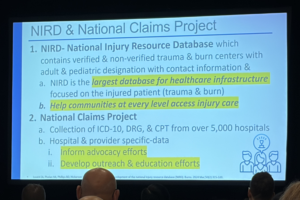
Presentation at the 2026 Burn Surgeon Forum..
How can advances in burn surgery translate into better care—and how can stronger connections across the injury research community accelerate that progress? Those questions connected the practical and scientific discussions at the American Burn Association’s Burn Surgeon Forum, held September 23–25 in San Antonio.
The program addressed difficult clinical decisions, including reconstruction of severely burned faces and hands, management of extensive burns with limited skin donor sites, and integration of rehabilitation into surgical care. Participants also examined pediatric burn centralization versus local care, workforce challenges, and multidisciplinary coordination in complex cases.
“BSF 2026 connected surgical innovation with practical application through case-based learning, focused peer discussions, and engagement with industry on emerging burn-care technologies,” explained Ed Dellert, ABA’s Executive Director.
For CNTR, the meeting’s emphasis on collaboration also underscored an ongoing priority: strengthening connections between burn research and the broader trauma research community. Although burns are traumatic injuries, burn care and research have often developed along distinct professional pathways.
“Burn research belongs at the table whenever we discuss the future of trauma care,” said CNTR’s Executive Director Michelle Price, PhD. “ABA’s participation as a core member in CNTR since our founding has helped build those connections. We can strengthen them by bringing investigators together around shared research questions and ensuring that burn patients are represented in broader injury research priorities.”
ABA’s Past President Jeff Carter, MD, echoed that vision, “The next era of burn care will be defined not by burn surgery alone, but by an interdisciplinary community of injury-care professionals united across the continuum of care,” he said.
Turning that vision into collaborative research offers a practical next step. The forum’s attention to surgical outcomes, rehabilitation, and research rigor provides several starting points for investigators across specialties.
John Kubasiak, MD, who represents ABA on CNTR’s board of directors, led a research session focused on research rigor and collaboration. “There are opportunities for burn and trauma investigators to develop studies together, agree on meaningful measures of recovery, and learn from one another’s approaches,” he said. “Through ABA and CNTR, we can connect researchers across centers and disciplines to pursue questions that matter to patients—from their initial treatment through long-term recovery.”
Those connections can extend the forum’s impact beyond the meeting itself, helping translate shared expertise into stronger studies and better care for people living with burn and other traumatic injuries.
Recordings of Burn Surgeon Forum presentations are now available on demand: ACCESS THE RECORDINGS.